
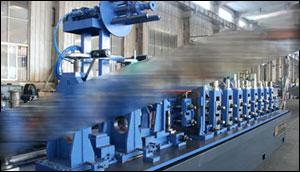
In the world of modern industrial manufacturing, high frequency welding pipe lines represent a pinnacle of efficiency, strength, and precision. This advanced process is the backbone for producing millions of tons of steel tubing used in construction, automotive, and furniture applications every year. But what exactly is this technology, and how does it transform a simple steel coil into a perfectly formed, high-integrity pipe? This definitive guide will walk you through the entire process, from raw material to finished product.
What is High Frequency Welding? A Technical Breakdown
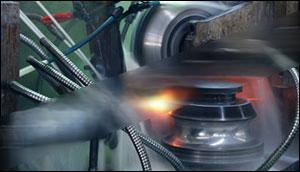
High frequency welding pipe manufacturing, often referred to as Electric Resistance Welding (ERW), uses the principle of induced electrical current to create a bond. As the formed steel edges are brought together, a high-frequency electrical current (ranging from 100 to 800 kHz) is applied directly to the metal. This current concentrates on the edges, heating them to a molten or forgeable state almost instantaneously. Pressure is then applied to forge the edges together, creating a seam that is often as strong as, or even stronger than, the parent metal itself. For an in-depth scientific look, the American Welding Society (AWS) provides extensive resources on welding methodologies.
The Unbeatable 5 Advantages of HF Welded Pipe
Why has this method become so dominant? The benefits of using a high frequency welding pipe line are substantial:
-
Exceptional Weld Strength: The forge-welding process creates a dense, homogeneous seam with minimal slag or impurity, leading to superior mechanical properties.
-
High Production Speed: Modern HF welding lines can operate at astonishing speeds, often exceeding 100 meters per minute, making it a highly efficient mass-production method.
-
Superior Surface Finish: The process does not require a filler metal, resulting in a clean, smooth weld seam with an excellent finish, both inside and out.
-
Material Efficiency: This method produces very little waste compared to other pipe-forming techniques, optimizing material usage and reducing cost.
-
Precision and Consistency: The entire process is automated and computer-controlled, ensuring that every meter of pipe produced meets exact dimensional tolerances.
A Deep Dive into the 8-Step High Frequency Welding Pipe Process
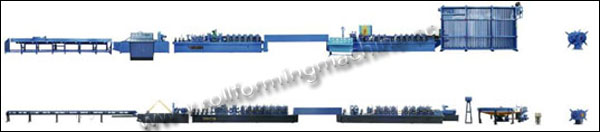
The transformation from steel coil to finished pipe is a continuous, seamlessly integrated operation. Here is a step-by-step breakdown of the high frequency welding pipe line procedure:
-
Uncoiling: The process begins with a massive coil of steel, either hot-rolled or cold-rolled mild steel, being loaded onto an uncoiler.
-
Shearing & End Welding: The leading end of a new coil is sheared and welded to the trailing end of the previous coil. This creates a continuous strip of steel, allowing the production line to run non-stop.
-
Vertical Accumulating: An accumulator, often a series of looping towers, stores a significant length of the steel strip. This crucial buffer allows the line to maintain speed while a new coil is being prepared and welded at the beginning.
-
Leveling and Forming: The steel strip passes through a leveler to remove any coil memory or curvature. It then travels through a series of forming rolls that gradually bend the flat strip into a circular tube shape.
-
HF Welding: This is the heart of the operation. The open-edged, circular shell passes through the high frequency welding unit. Here, the edges are heated and forged together under pressure to create the solid-state weld.
-
Scraper and Cooling: Immediately after welding, a bead of excess material, or “weld flash,” is scraped off from both the inside and outside of the pipe. The weld zone is then rapidly cooled to normalize the grain structure.
-
Sizing and Straightening: The still-hot pipe passes through a sizing mill, a set of calibrated rolls that ensure the final pipe diameter is perfectly round and within tight tolerances. A straightening machine then removes any residual curvature.
-
Flying Saw and Run-Out Table: Finally, the continuous pipe is cut to predetermined lengths by a flying saw that moves synchronously with the pipe. The finished pipes are then conveyed via a run-out table for inspection, bundling, and shipment.
Key Technical Specifications for a Modern Pipe Forming Machine
Understanding the capabilities of a high frequency welding pipe line is crucial for selecting the right equipment. Here are the typical main technical specifications:
-
Raw Material (Steel Coil) Condition:
-
Material: Hot-rolled or cold-rolled mild steel (e.g., ASTM A36, SS400, Q235).
-
Coil Weight: Can range from 3 to 20+ tons depending on the mill size.
-
Coil Width: Determines the final pipe diameter.
-
Coil Thickness: Typically ranges from 0.6mm to 12mm or more.
-
-
Finished Product Requirements:
-
Shape: Primarily round pipe, but lines can be configured for square or rectangular tubing.
-
Diameter Range: For a standard line, this can be φ12.7mm (1/2″) up to φ165mm (6″) or larger. The line you described covers a common range of φ12.7~φ38.1mm.
-
Wall Thickness: Directly related to the input strip thickness, commonly from 0.6~1.8mm for lighter gauge pipes up to several inches for heavy-wall line pipe.
-
-
Production and Layout:
-
Production Speed: Highly variable, but modern mills can achieve speeds of 0~100 m/min or even higher for smaller diameters.
-
Layout: Overall layout is linear, typically in an “input, side output” configuration for efficient material flow.
-
Conclusion: Why HF Welding is the Future of Pipe Production
High frequency welding pipe technology is a testament to industrial innovation. It delivers a perfect combination of speed, quality, and cost-effectiveness that is essential for today’s global infrastructure and manufacturing needs. By understanding the process, advantages, and specifications outlined in this guide, you can appreciate the engineering marvel that produces the strong, reliable pipes that build our world. For further reading on international standards for these pipes, organizations like ASTM International provide detailed material and testing specifications.
Contact us now.