Mastering Material Handling: A Comprehensive Guide to Slitting with Decoiler and Uncoiler
Slitting with decoiler and uncoiler is a fundamental and efficient process in metalworking and roll forming lines for preparing coil stock. This method precisely unwinds a wide master coil and cuts it into multiple, narrower strips of specific widths, which are then neatly rewound for the next production stage. Understanding the equipment and process is crucial for optimizing productivity and material yield in manufacturing.
How Does the Slitting with Decoiler and Uncoiler Process Work?
The process involves three key pieces of equipment working in tandem:
-
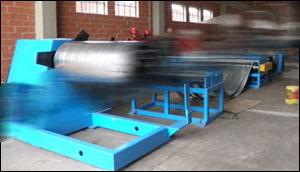
The Decoiler (or Uncoiler): This machine holds and steadily feeds the large, heavy master coil into the slitter. It controls the tension and ensures smooth, consistent unwinding.
-
The Slitter Itself: This is the heart of the operation, featuring hardened steel rotary knives (disc cutting blades) that make the longitudinal cuts. The arrangement of these knives on arbors determines the final strip widths.
-
The Recoiler (or Rewinder): After slitting, the individual strips are separated and guided to rewind onto separate mandrels, creating neat, manageable sub-coils ready for further processing.
Using a dedicated decoiler and uncoiler system for slitting is vastly superior to manual handling, as it dramatically increases speed, improves safety, ensures consistent tension, and minimizes material waste. For an industry overview of coil processing, the Fabricators & Manufacturers Association (FMA) provides excellent technical resources.
Key Specifications for an Effective Slitting Line
Based on a standard and popular model, here are the critical specifications that define the capability of a slitting with decoiler and uncoiler system:
-
Material Handling: Designed for steel coils with a feeding width of 1000-1300mm and a thickness range of 0.4-1.5mm.
-
Power & Speed: Driven by a robust 2.2KW motor, it offers an adjustable line speed of 0-30 meters per minute, allowing for precise control based on material type.
-
Cutting Core: Utilizes the efficient disc cutting way. The critical slitter arbors and knives are key components.
-
Critical Component Quality: The rollers and arbors are constructed from Gcr15 bearing steel, which is then quenched to HRC58-60. This provides extreme hardness, wear resistance, and longevity, essential for maintaining clean cuts and tolerances.
-
Output & Drive: A typical configuration can produce 7 strips per cycle. The power transmission is handled reliably via chains, ensuring strong, synchronized movement.
5 Major Benefits of Using a Dedicated Slitting Line
-
Increased Productivity: Automating the uncoiling, slitting, and recoiling process is exponentially faster than manual methods, keeping your roll forming or stamping lines fed without delay.
-
Superior Precision & Consistency: Precision-ground disc knives and tension-controlled unwinding result in strips with clean, burr-minimized edges and exact widths, critical for downstream manufacturing quality.
-
Enhanced Material Utilization: By slitting a master coil into needed widths on-demand, you reduce off-cuts and scrap, optimizing material yield and lowering costs.
-
Improved Safety: Automated handling removes workers from the dangerous tasks of manually wrestling heavy, unwieldy coils and handling sharp edges.
-
Operational Flexibility: With adjustable knife positions and tension controls, one slitting line can be quickly reconfigured for different strip widths and material grades, making it a versatile asset.
Choosing the Right System for Your Needs
Slitting with decoiler and uncoiler equipment is not one-size-fits-all. When selecting a system, consider:
-
Material Type: Beyond mild steel, will you process galvanized, aluminized, or stainless steel? Knife material and line tension may need adjustments.
-
Coil Dimensions: Match the machine’s maximum coil weight, inner diameter (I.D.), outer diameter (O.D.), width, and thickness capacity to your standard stock.
-
Required Tolerance: The precision of the knife setup, arbor rigidity, and bearing quality directly impact the dimensional accuracy of your slit strips.
-
Integration: Ensure the slitting line can be seamlessly integrated with your existing cold roll forming machine, shear, or press feeder.
These systems are indeed very popular and normally used parts for cold roll forming machines, but their application extends to any industry preparing coiled metal, from automotive to construction. For deeper technical standards on slitting tolerances, organizations like the American National Standards Institute (ANSI) publish relevant guidelines.
By investing in a proper slitting with decoiler and uncoiler line, you invest in the efficiency, quality, and scalability of your entire metal fabrication operation.
Contact us for more inforamtion about cold roll forming machines.